
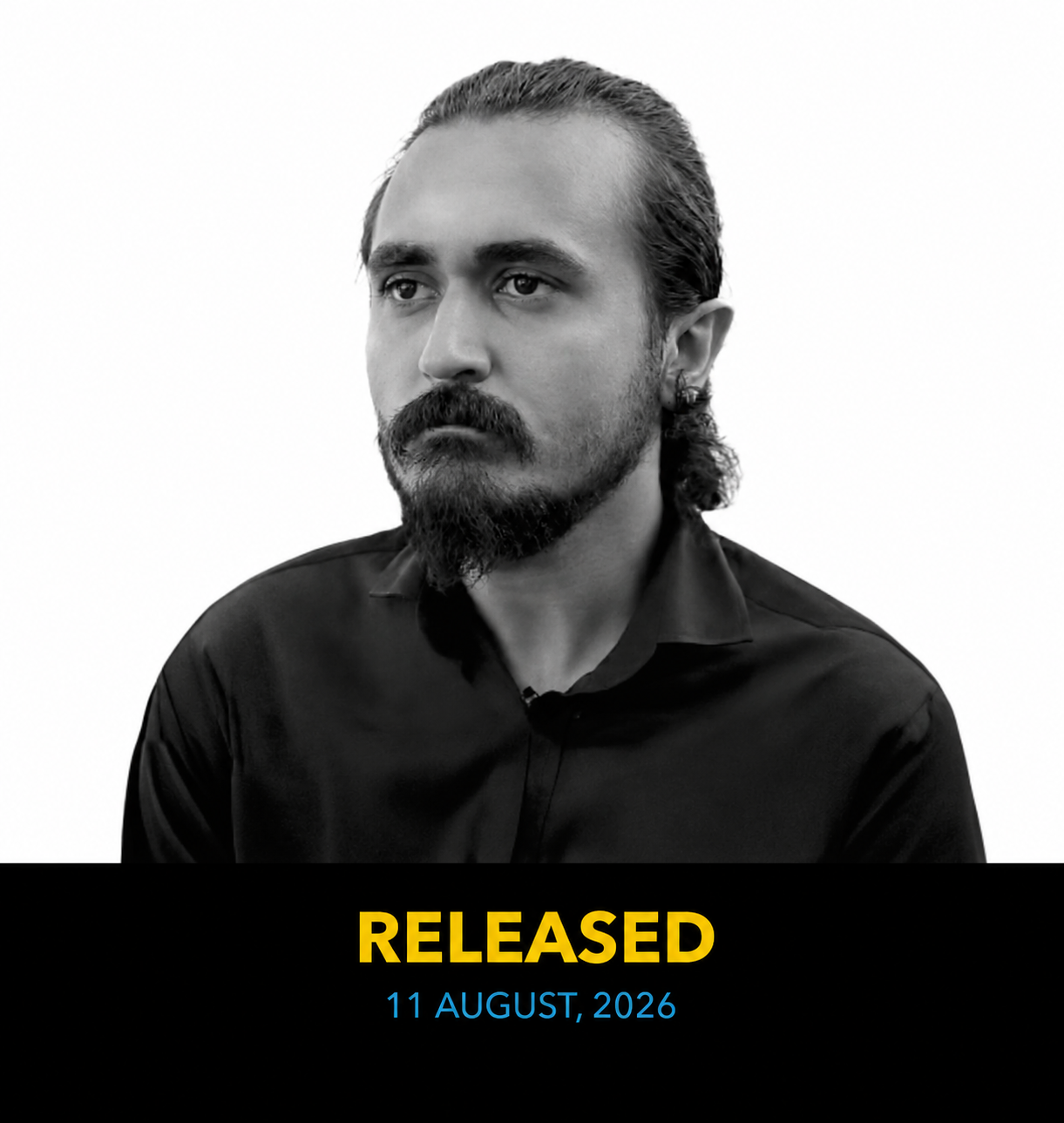
Elvin Mustafayev
A unionist and labour activist who was sentenced to 3 years in prison on January 31, 2024, and released on August 4, 2026, after completing his sentence.
-
CASE STATUSReleased
-
RELEASED FROMReleased from the Prison
-
GROUPActivist
Date of Birth:15 February 1996
Detained since: 4 August 2023
Released: 11 August, 2026, after completing his sentence.
Affiliation: Member, Labour Desk Trade Unions Confederation (İşçi Masası)
Charges:
- Illegal acquisition, possession, processing, or transportation of narcotic substances in large quantities, with intent to sell (Art. 234.4.3 of the Criminal Code)
- Later reclassified as possession of a significant quantity of narcotic substances without intent to sell (Art. 234.1-1 of the Criminal Code)
Conviction and Sentence:
On 31 January 2024, Elvin Mustafayev was sentenced to three years in prison by the Baku Assize Court for alleged drug possession.
The Baku Court of Appeal and the Supreme Court of Azerbaijan both upheld the verdict, most recently on 22 May 2025.
Political Prisoner Status:
His detention meets criteria (a) and (e) of PACE Resolution 1900 (2012):
-
Violation of freedom of expression and association under the European Convention on Human Rights (ECHR).
-
His prosecution is politically motivated, aimed at silencing a grassroots labour organiser and weakening the only independent trade-union network in Azerbaijan.
Summary:
Elvin Mustafayev is a gig-economy courier and labour-rights activist, and a member of the Labour Desk Trade Unions Confederation—the country’s only independent and alternative union representing delivery and platform workers.
He was detained on 4 August 2023 following a courier protest against new licensing regulations for motorcycles that restricted delivery work. The next day, the Binagadi District Court ordered his arrest on charges of large-scale drug trafficking (Article 234.4.3 of the Criminal Code)—an accusation widely viewed as fabricated. In September 2023, prosecutors escalated the case to include conspiracy and organised-group drug trafficking, before the court later downgraded the indictment to simple possession (Article 234.1-1) in January 2024.
His prosecution—known as part of the “Labour Desk (İşçi Masası) case”—is emblematic of the criminalisation of labour organising in Azerbaijan. The trial was based solely on police testimony and a state-controlled forensic report confirming only the nature of the seized substance, without independent evidence linking Mustafayev to it. The search and “discovery” of drugs occurred without neutral witnesses, and defence motions for independent verification or CCTV footage were denied.
Mustafayev consistently stated that he was followed by plainclothes police, beaten, and accused after narcotics were planted on him—claims never investigated. The court disregarded allegations of coercion, refused to open an inquiry, and treated his defence as “self-serving.” No credible evidence supports the accusations, and the proceedings violated fair-trial standards under Articles 5, 6, 10, and 11 of the ECHR.
From prison, Mustafayev has endured harsh treatment, including solitary confinement and punishment cells. In May 2025, he launched a hunger strike in solidarity with political prisoners, after which he was transferred to a high-security facility and physically abused, according to reports confirmed by his lawyer and independent human-rights monitors.
His arrest fits within a broader, state-engineered campaign to suppress independent civic actors, especially grassroots labour initiatives that emerged after the adoption of restrictive laws—the Law on Media (2021) and Law on Political Parties (2022)—criticised by the Venice Commission. Following these laws, repression intensified throughout 2023, targeting new generations of activists, including gig-economy workers and informal networks.
The absence of credible evidence, procedural irregularities, and politically charged narrative confirm that Elvin Mustafayev’s conviction was designed to punish and deter independent worker organising.
International organisations, including Amnesty International and Human Rights Watch, have condemned the charges and verdict as politically motivated and unjust.