|
Caspian Wire
Free Voices Collective
Azerbaijan human rights related news
|
MARCH 2026
|
|
|
March 2026 was defined by two parallel crises: an accelerating crackdown inside Azerbaijan, with heavy sentences against journalists, activists, and opposition figures, and an external shock when Iranian drones struck the Nakhchivan exclave on March 5, pulling the country into the widening regional conflict. This bulletin documents both, drawing on verified reporting from independent Azerbaijani media and international human rights organizations.
|
|
| 01 |
Nine Women Journalists Behind Bars on Women’s Day |
|
|
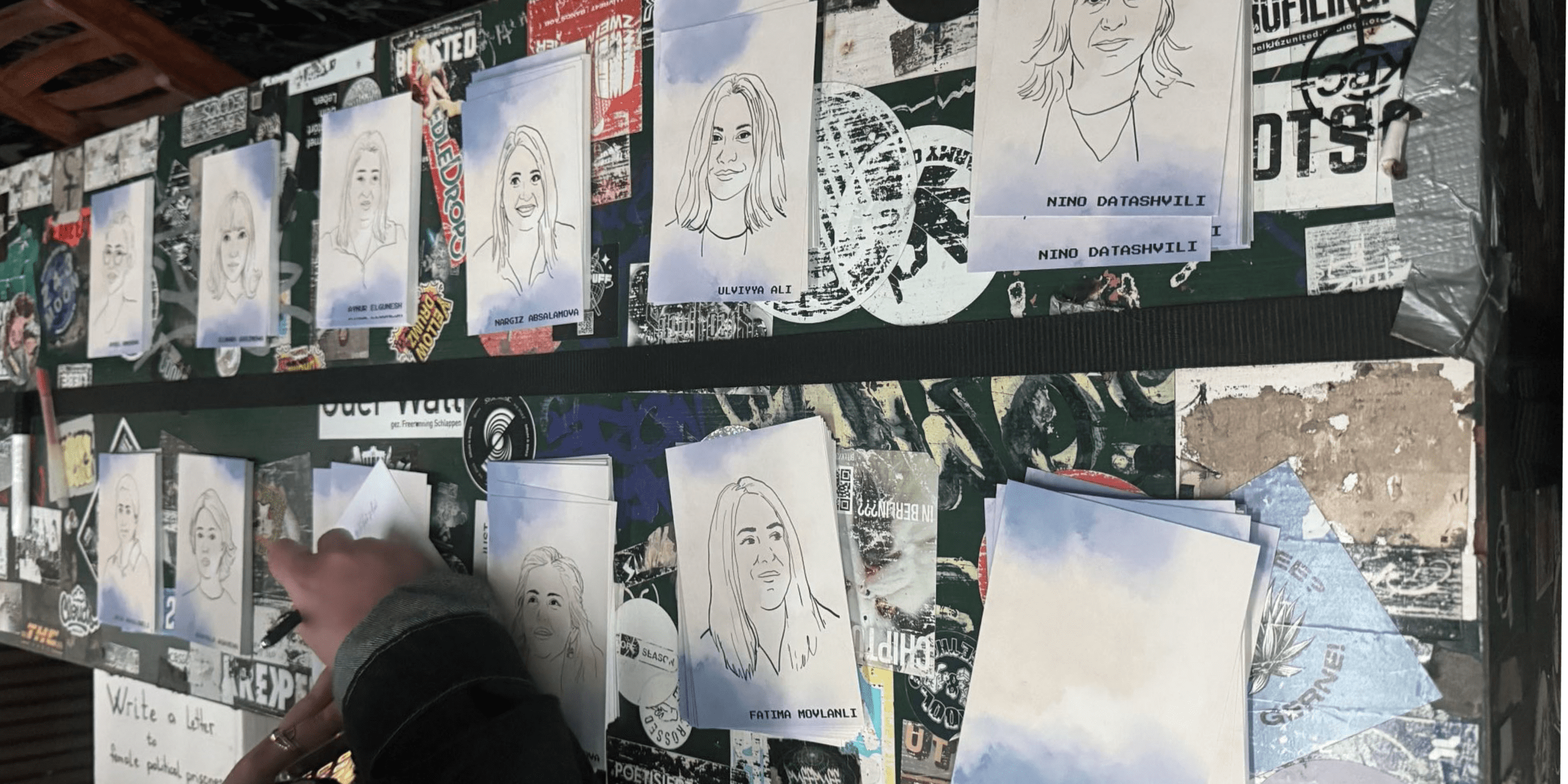
As the world marked International Women’s Day on 8 March, nine women journalists in Azerbaijan were spending it in prison — jailed on spurious charges for their independent reporting. The Norwegian Helsinki Committee published a dedicated report on 9 March documenting their cases and calling for their immediate release.
|
|
The Nine Women
|
|
Azerbaijan ranked 167th out of 180 countries in RSF’s 2025 Press Freedom Index — the highest number of politically motivated journalist imprisonments since independence. At least 25 media workers are currently jailed or under investigation.
Several detainees suffer from serious health conditions and are being denied adequate medical care. The case of Aynur Elgunash is particularly alarming. She has a disablity, has undergone multiple surgeries, and requires ongoing treatment unavailable in detention. Amnesty International confirmed in February that at least three Meydan TV journalists are being denied urgently needed medical care.
|
|
Fatima Movlamli: “Freedom — One Year Behind”
|
|
On 28 February, journalist Fatima Movlamli marked one year of detention at Baku Investigation Detention Center by writing a letter published by Meydan TV. She described her arrest in striking terms, where masked operatives surrounding her, handcuffs without explanation, a planted search, money hidden under her pillow, and a “puppet judge” fulfilling the order the next day.
|
|
“I felt free the moment I was arrested — because I had known for a long time that it was coming. I chose this prison, along with all the deprivations that came with it.”
— Fatima Movlamli, Baku Investigation Detention Center, 28 February 2026
|
|
| 02 |
Wave of Harsh Sentences in March |
|
|
March saw a striking volume of heavy prison sentences handed to civil society activists, and political figures — all of whom reject the charges as politically motivated.
| Azer Gasimli, political scientist — 12 years (March 11). |
|
| Zamin Zaki, social worker, NGO case — 7.5 years (March 11). |
|
| Ahmad Mammadli, founder of Yoldash Media — 6 years (March 16). |
|
|
|
|
|
| Martin Ryan, French businessman — 10 years on espionage charges (March 17). |
|
|
Tofiq Yaqublu: “They Will Kill Me Like Navalny”
|
|
Opposition politician Tofiq Yaqublu began a hunger strike again, in protest against his unjust sentencing and had gone without food for at least 24 days by late March. His daughter stated: “Responsibility for his life rests with Ilham Aliyev.” Yaqublu had reportedly said: “I choose my own death” and “They will kill me like Navalny in the end.” His family appealed to the president for house arrest.
|
|
APFP: Party Under Systematic Dismantlement
|
|
On 2 March, Emil Salim, Chair of the APFP Youth Committee, was transferred from administrative detention to the State Security Service (DTX). Family and lawyer were denied information on his whereabouts for days. APFP stated the 20-day administrative sentence for “spreading false information online” was a pretext for SSS interrogation. More than 20 APFP members are currently detained on various charges. Party leader Ali Karimli and Presidium member Mammad Ibrahim face charges of attempting to forcibly seize power, which the party categorically rejects.
|
|
NGO Case — Civil Society Criminalized
Prosecutors launched criminal investigations against multiple NGOs in 2025 for “illegal entrepreneurship” and “tax evasion,” leading to continued prosecution of Bashir Suleymanli (Institute for Civil Rights), Mammad Mammadzade (Election Monitoring Alliance), Asaf Ahmadov, and Zamin Zaki. Suleymanli’s family reported he is being subjected to pressure in isolation.
|
| 03 |
Detention Conditions & Ill-Treatment |
|
|
Labor rights activist Aykhan Israfilov wrote from Penitentiary Colony No. 10 that a “barracks dictatorship” has taken hold there, with systematic social isolation and collective punishment. Separately, prisoners at the same colony were reportedly forced to stand in outdoor formation in the rain at temperatures at or below 12°C — a violation of minimum detention standards under Azerbaijani law, which prohibits outdoor formation below that threshold.
Two believers were detained in March, reportedly on religious grounds. One stated: “Police tried to put my head in the toilet.”
|
|
“A real barracks dictatorship has formed here.”
— Aykhan Israfilov, labor rights activist, writing from Penitentiary Colony No. 10, March 2026
|
|
| 04 |
Media Freedom: Courts, Censorship & Threats |
|
|
“Ilham Aliyev,” “Dictatorship,” “Regime” Struck from Court Hearings
|
|
Akif Gurbanov, spokesman for the Third Republic Platform, reported in March that court protocols are being systematically edited to remove political terms such as “Ilham Aliyev,” “dictatorship,” and “regime” — even when defendants use these words in open court. The practice effectively falsifies the historical record of political trials.
|
|
Female Journalists Threatened with New Criminal Cases
|
|
The warden of Baku Investigation Detention Center threatened the women detained in the Meydan TV case with new criminal charges if they did not comply with facility rules — a form of institutional intimidation documented and published by Meydan TV in March.
|
|
RSF: Free All Jailed Journalists
|
|
Reporters Without Borders called in March for the release of journalist Farid Mehralizada and all journalists detained in Azerbaijan. Mehralizada stated: “I was arrested for my economics reporting at Radio Free Europe/Radio Liberty.” The CoE Platform for the Protection of Journalism counted 30 imprisoned journalists in Azerbaijan as of 31 December 2025.
|
|
Supreme Court Issues “Right to be Forgotten” Ruling
Azerbaijan’s Supreme Court issued a “right to be forgotten” interpretation in March allowing individuals to demand deletion of published online information. Experts warned this mechanism could be weaponized by powerful figures to suppress accountability journalism and erase inconvenient reporting from the public record.
|
| 05 |
Iranian Drones Strike Nakhchivan |
|
|
On 5 March, two Iranian kamikaze drones struck Azerbaijan’s Nakhchivan exclave in the first direct military strike on Azerbaijani territory since the war in Iran. One drone hit the terminal of Nakhchivan International Airport, another landed near a school in the village of Shakarabad. Two civilians were injured. The attack occurred as the US–Israel–Iran conflict widened across the region.
President Aliyev called it a “terrorist act” and vowed those responsible would face Azerbaijan’s “Iron Fist.” Azerbaijan’s Ministry of Foreign Affairs formally blamed Iran, Iranian armed forces denied responsibility.
|
|
“The Azerbaijani state strongly condemns this ugly terrorist act, and those who committed it must be immediately held accountable.”
— President Ilham Aliyev, 5 March 2026
|
|
|
Border Closure
|
|
Azerbaijan’s Cabinet of Ministers immediately suspended all freight transit at the Iranian border on 5 March. Over 500 drivers were stranded at the Astara crossing, with goods spoiling and fuel running out. By midnight on 6 March, approximately 1,500 trucks had accumulated. Qazetci correspondents reported drivers telling them: “We’ve been in Iran for over 15 days. Our fuel is running out. Our money is gone. We called the embassy — no one picked up.” Freight transit resumed on 6 March.
|
|
International Reactions
|
| United States: State Department “strongly condemns” the “unprovoked drone attack by the Iranian regime” targeting civilian infrastructure and a children’s school. |
|
| Turkey: Condemns strikes on “third countries,” reaffirms solidarity with Azerbaijan. |
|
| European Union: Foreign policy chief Kaja Kallas calls the strikes “completely unacceptable” and warns of escalation risk beyond the Middle East. |
|
|
Geopolitical Context
Analysts at the Gulf International Forum and CEPA note that Nakhchivan sits at the heart of the planned east-west TRIPP corridor (linking Baku to Turkey and European markets) — a route Iran views as a strategic threat. As IRGC capacity weakens under US and Israeli pressure in western Iran, the South Caucasus is being pulled into a secondary conflict zone. President Aliyev declared the army had been placed on its highest level of mobilization readiness.
|
| 06 |
International Accountability |
|
|
Council of Europe: ECHR Rulings Not Implemented
|
|
The Council of Europe’s Committee of Ministers formally stated in March that Azerbaijan is failing to implement European Court of Human Rights rulings related to the arbitrary detention of government critics. The Committee noted these are not isolated cases but reflect a systemic pattern. Azerbaijan continues to engage selectively with Council of Europe bodies, retaining the benefits of membership while ignoring accountability conditions.
|
|
ECHR: €130,000+ Against Azerbaijan for Forced Demolition
|
|
The European Court awarded over €130,000 in compensation to a family whose apartment in Baku’s Sabail district was demolished without adequate process or remedy — a case involving forced evictions and property rights violations.
|
|
UN Submission: Torture Is Systemic
|
|
A statement submitted to UN mechanisms in March documented that torture and human rights violations in Azerbaijan are systemic. The submission referenced doctoral researchers Bahruz Samadov and Igbal Abilov, arrested in 2024 for peaceful academic activity, as illustrative of the broader pattern.
|
|
HRW: Formula One Should Put Human Rights in the Driver’s Seat
|
|
Human Rights Watch called on Formula One ahead of the Baku Grand Prix to use its leverage to press for the release of political prisoners — noting the stark contradiction of hosting a major international event while journalists and activists remain behind bars.
|
| 07 |
Repression Beyond Azerbaijan’s Borders |
|
|
HRW documented in February that Azerbaijan is expanding its crackdown on activists in exile. Starting from March 2025, criminal investigations were launched in absentia against several exiled bloggers on charges including terrorism, incitement to mass riots, fraud, and attempted coup. All deny the allegations.
However, on the other hand, a source who had been blocked from leaving Azerbaijan told Qazetci they were permitted to leave only after Russia’s SVR Director Sergey Naryshkin personally called President Aliyev.
|
|
Note
A statement published by Qazetci in March reported an intimidation and smear campaign against the outlet. The editorial board issued a public statement rejecting the pressure and affirming their commitment to independent reporting.
|
|
| 08 |
Energy, Sanctions & Geopolitics |
|
|
An EU energy commissioner publicly described Azerbaijani gas supplies as “a pillar of European energy security” amid the Middle East crisis — a framing that critics argue provides Baku with political cover for its human rights record. The Southern Gas Corridor continues to create structural incentives for European institutions to soften public criticism of Azerbaijan.
SOCAR’s Kulevi terminal in Georgia narrowly escaped inclusion on the EU’s latest Russia sanctions list — an outcome that Abzas Media described as significant and that raises questions about the consistency of sanctions enforcement where Azerbaijani state energy interests are involved.
|