|
Caspian Wire
Free Voices Collective
Azerbaijan human rights monitor
|
July 2026
|
|
|
|
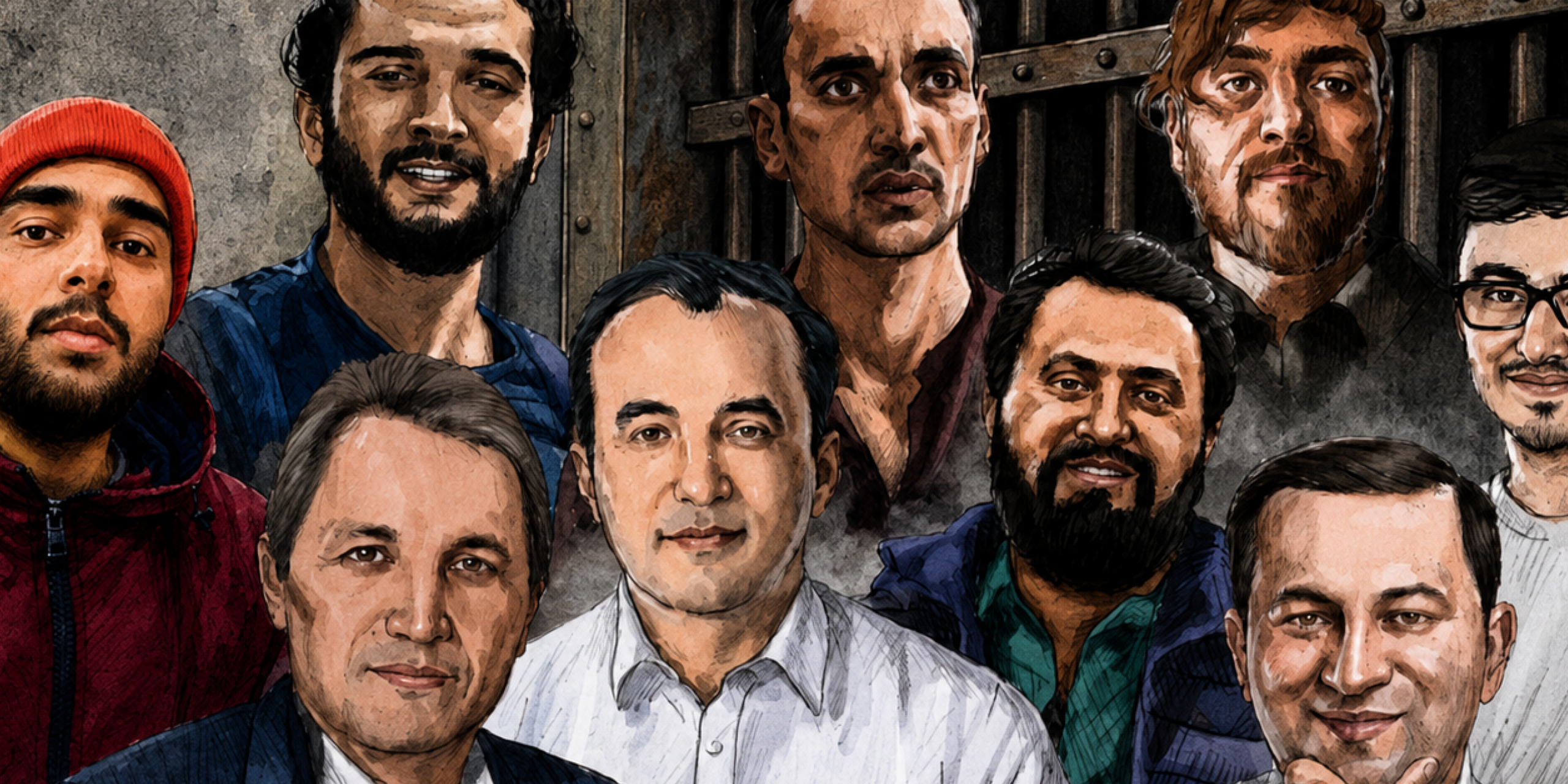
July 2026 brought the harshest media sentences in Azerbaijan’s recent history: nine people connected to Toplum TV received 12 to 15 years each. Punishment cells, hunger strikes, and denied medical care recurred almost daily across the prison system, while European Commission President Ursula von der Leyen visited Baku and discussed energy and “peace” without mentioning political prisoners in public. President Ilham Aliyev responded to PACE’s continued suspension of Azerbaijan’s voting rights by threatening full withdrawal from the Council of Europe.
|
|
01
Toplum TV: Verdict and Sentencing
|
|
Nine Sentenced to 12–15 Years
|
|
On 27 July, the Baku Court for Grave Crimes sentenced nine people in the “Toplum TV case” to between 12 and 15 years in prison, plus 2.5 years’ disqualification from holding certain positions: Akif Qurbanov and Ruslan Izzatli (15 years each), Alasgar Mammadli and Ali Zeynalov (14 years), Ramil Babayev, Mushfig Jabbarov, and Ilkin Amrahov (13 years each), and Farid Ismayilov and Elmir Abbasov (12 years). Abbasov, who had remained free during the investigation, was arrested in the courtroom itself. Editor Shahnaz Baylargizi was placed under police supervision.
The case originated in a March 2024 police raid on Toplum TV and the Democratic Initiatives Institute; charges were escalated from a single smuggling count to seven articles of the Criminal Code. At sentencing, Ramil Babayev read his own poem, “We Are Burying Justice,” to the court. One defence lawyer summarised the disproportion in closing arguments: “A murderer gets 9 years, a judge who killed his wife gets 7, but a journalist gets 13.”
|
|
International Reaction Unusually Unified
|
|
Human Rights Watch called the sentences the harshest yet in the years-long campaign against independent media, exceeding even the 7.5–9 years given to Abzas Media journalists in June 2025. RSF said Aliyev “has brought the judiciary under his control to silence the country’s last remaining independent media outlets,” and noted that Alasgar Mammadli has thyroid cancer and lacks adequate treatment in detention. The European and International Federations of Journalists called the verdicts “blatant government repression and intimidation,” adding: “The whole world is watching.” IPI and ECPMF issued similar statements, the latter linking the case to a broader wave of repression spanning Abzas Media and Meydan TV.
|
|
02
Meydan TV Trial: Defiant Testimony
|
|
The separate “Meydan TV case” continues at the Baku Court of Grave Crimes under a new judicial panel installed without explanation in May. At the 24 July hearing, editor-in-chief Aynur Elgunash testified that her arrest had been pre-planned, citing a state surveillance order issued six months before her detention, and described €13,500 in cash she says was planted under her pillow during a search, however forensic examiners found fingerprints on only 4 of 162 banknotes.
Journalists Fatima Movlamli and Ramin Deko also testified, denouncing the smuggling charges as fabricated. Ramin Deko read a poem in court. Defendants have refused to answer prosecutors’ questions while cooperating fully with their own counsel. Khayala Agayeva’s phone calls with friends were cut and not restored on 23–24 July, echoing an identical incident affecting Aytaj Tapdig in June. Next hearing: 7 August.
|
|
03
Ali Karimli: Escalating Pressure
|
|
Detained since 29 November 2025, Ali Karimli (APFP chair) reported escalating restrictions this month, apparently retaliatory after a France 24 interview: his daily walk time was cut from two hours to one, phone contact with family was repeatedly interrupted, and his handwritten legal notes and television access were confiscated. His defence says a cellmate with mental-health issues, moved into his cell after the interview, disrupts his sleep nightly with loud religious rituals. Courts have refused to accept complaints about his treatment.
Two of Karimli’s former bodyguards were prosecuted in July. Kanan Zeynalov was sentenced to 9 years on 30 July on a disputed stabbing charge he says was staged, and Bahruz Hasanli was detained in Kharkiv, Ukraine on 27 July under an Azerbaijani extradition request tied to a 2021 fraud allegation. More than 20 APFP members and activists remain jailed.
|
|
04
Other Trials and New Arrests
|
|
“NGO Case”: Prosecutors Seek 14 and 13 Years
|
|
On 24 July, prosecutors demanded 14 years for Anar Mammadli, head of the Election Monitoring and Democracy Studies Center, and 13 years for activist Anar Abdullayev. In a related strand of the same broader case, social worker Zamin Zaki had his 7-year-6-month sentence reduced by three months on appeal, and Nargiz Mukhtarova, wife of jailed Abzas Media journalist Farid Mehralizada, received a 7.5-year suspended sentence with 3 years’ probation.
|
|
Samira Gasimli Named a Criminal Defendant
|
|
Samira Gasimli, wife of jailed political scientist Azer Gasimli, who was sentenced to 12 years in prison, was named a defendant on defamation charges on 14 July in what she calls a “political order”.
|
|
Four Jailed Over USSR Flag March
|
|
On 29 July, Nizami District Court sentenced four people to 1.5–2 years for attempting a march carrying Soviet-era flags, on charges of promoting communist ideology. Separately, Lawyer Zabil Gahramanov, who had won acquittals against local police in prior cases, had his investigation close and trial begin, a move the International Union of Lawyers called likely retaliation.
|
|
05
Conditions in Detention
|
|
Punishment Cells and Hunger Strikes
|
|
Punitive isolation in punishment cells recurred almost daily through July, disproportionately affecting religious-belief prisoners and civic activists. Civic activist Nijat Ibrahim spent 26 days in solitary confinement and had his regime escalated to closed-prison status. Ex-“Muxalifat” newspaper employee Yashar Agazade began an 18-day dry hunger strike after writing to Ursula von der Leyen; his cell term was extended in response. Lankaran detainee Mansur Valishov was placed in solitary confinement twice, once for protesting a beating, once for requesting help for a dying fellow inmate, and began a hunger strike after, he says, a prison chief told him “many sons like you have died here.” Four members of the Muslim Unity Movement began a coordinated hunger strike on 11–13 July demanding the release of nine jailed women journalists and six religious women.
|
|
Facility No. 17
Reported without water or electricity for days amid 40°C+ heat, according to imprisoned opposition figure Tofiq Yagublu, who is serving 9 years there.
|
|
|
Medical Neglect
|
|
Bahruz Samadov, a Charles University researcher serving 15 years, was confirmed on 29 July to have been denied any eye examination despite worsening vision; his family says he can now only look “at the sky” since he cannot focus on nearer distances. Aytaj Tapdig, held 20 months and having used 80 boxes of nasal spray, wrote an open letter noting Azerbaijan’s Penitentiary Service has no staff ENT doctor at all. Ulviyya Ali, who has a pituitary microadenoma, has been denied an annual MRI since February and denied gynaecological care after abnormal bleeding.
|
|
On 25 July, OMCT and FIDH issued a joint statement on behalf of five jailed Meydan TV journalists documenting a February 2026 cell search at Baku Investigative Detention Center No. 1, during which deputy chief Javid Gulaliyev allegedly choked one journalist while saying “I’m covered in blood up to my throat, that’s how it should be,” and exposed himself to detainees. The statement was signed by the Human Rights House Foundation and the Independent Lawyers Network alongside OMCT and FIDH.
|
|
06
New Laws: Internet and Social Media Controls
|
|
Websites Can Now Be Blocked Without a Court Order
|
|
Parliament passed amendments on 10 July expanding the government’s power to block websites without a court order, adding new categories, such as insult, defamation, privacy violations, and “false information” to a narrower 2017 standard. Lawyer Ruslan Aliyev warned the mechanism, already used against political rivals, will now be applied more broadly to critical media: “Afterwards you become the pedestrian and they become the rider — sites get blocked instantly, and it’s on the owner to fight the block through the courts.”
|
|
Social Media Registration Law Targets Exiled Critics
|
|
A law barring under-16s from individual social media accounts and requiring foreign platforms to register locally, answer government requests, and face fines or traffic-throttling for non-compliance took effect this summer.
|
|
Aliyev Signs Involuntary Psychiatric Hospitalisation Law
|
|
On 24 July, President Ilham Aliyev signed the amendments to the law on psychiatric care first advanced by parliament in June, formally granting prosecutors the power to refer people subject to administrative proceedings for compulsory psychiatric evaluation without their consent, where delays in care are said to pose a “threat to that person’s life or health, or the life or health of others.” Human rights defender Yalchin Imanov that the law’s wording around “danger” and mental disorder is undefined and vague, “fertile ground for abuse” against political activists and critics of the government.
|
|
07
EU and Council of Europe Relations
|
|
Von der Leyen Visits Baku, Says Nothing on Rights
|
|
On 1 July, European Commission President Ursula von der Leyen met Ilham Aliyev in Baku. Joint remarks covered energy, a €200 million EU pledge for Southern Caucasus connectivity, potentially catalysing up to €2 billion in investment, the Azerbaijan-Armenia “peace,” and the Southern Gas Corridor. Neither leader mentioned human rights or political prisoners in public remarks, despite pre-visit appeals from jailed Toplum TV defendants.
|
|
“I see no positive change in any direction.”
— Petra Bayr, PACE President, 2 July 2026
|
|
|
Bayr said Azerbaijan’s blacklist barring PACE members from the country remains an obstacle to dialogue, and called the “piece of paper” dismissal of PACE’s resolution “the problem itself, not a way out.” She said full expulsion from the Council of Europe is a worst-case outcome she does not want, though Article 52 sanctions remain theoretically possible.
|
|
Aliyev’s Counter-Threat
At the Shusha Global Media Forum on 13 July, Aliyev said Azerbaijan is considering full withdrawal from the Council of Europe, calling PACE’s suspension of its voting rights “unfair” and adding an exit “will not be felt domestically.” He dismissed ECtHR rulings as carrying “no force” for Azerbaijan and called for full repeal of the US Section 907 restriction.
|
|
|
|
Secret Baku Meeting Raises Sanctions-Evasion Questions
|
|
Die Zeit and ARD reported that former senior German and Russian officials, including ex-Merkel chief of staff Ronald Pofalla, held undisclosed talks in Baku on 12–14 July. Aliyev confirmed the visit occurred but denied advance knowledge; German Chancellor Friedrich Merz said the same. Azerbaijani commentators were skeptical Baku was truly unaware, and speculated the real subject was Russian energy being relabelled as Azerbaijani for EU export, timed against a proposed US Senate sanctions bill naming Azerbaijan, alongside China, India, Hungary and Slovakia, for 100% tariffs over Russian energy purchases.
|
|
Caspian Wire
Free Voices Collective
|
|
|